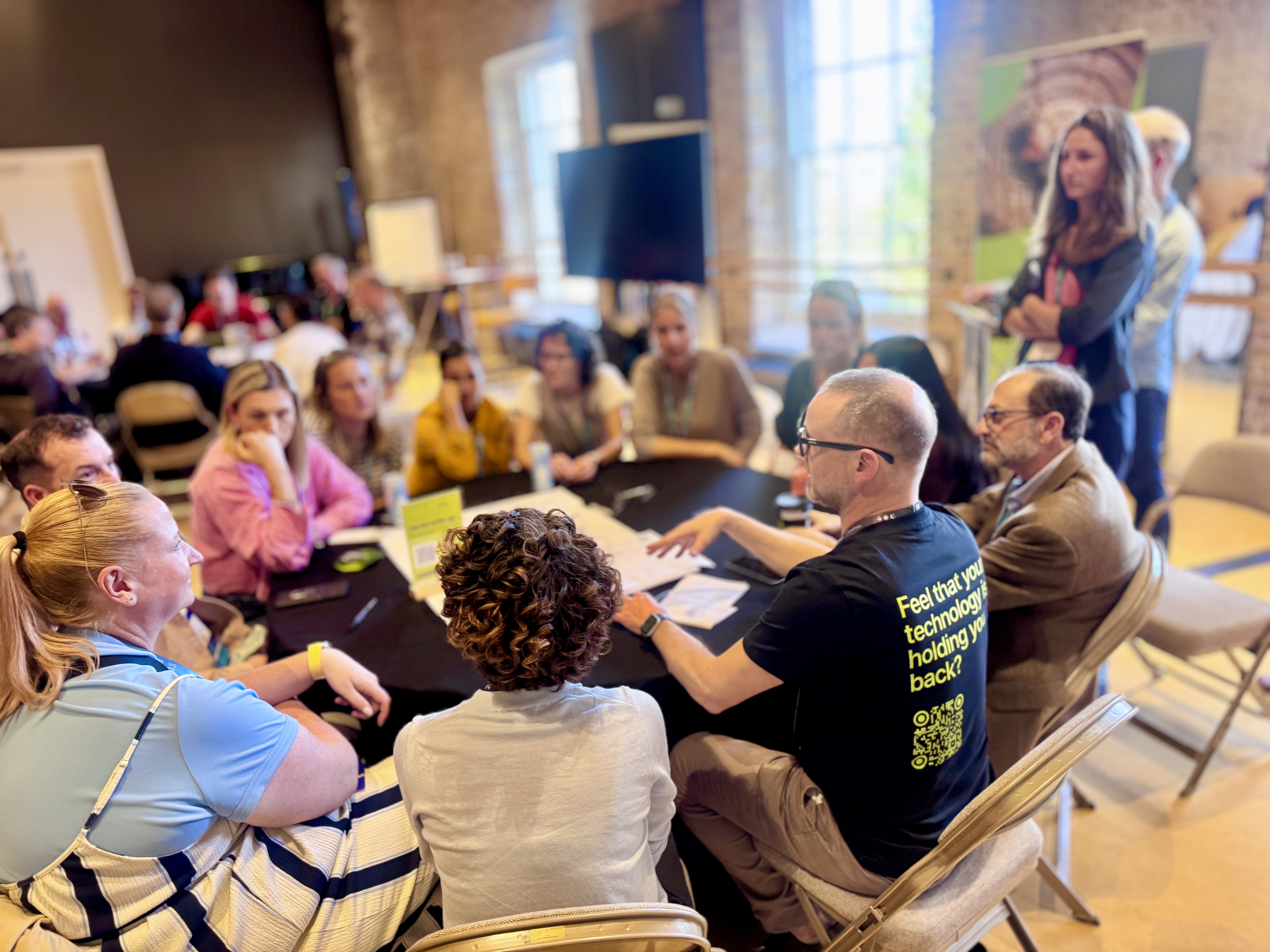
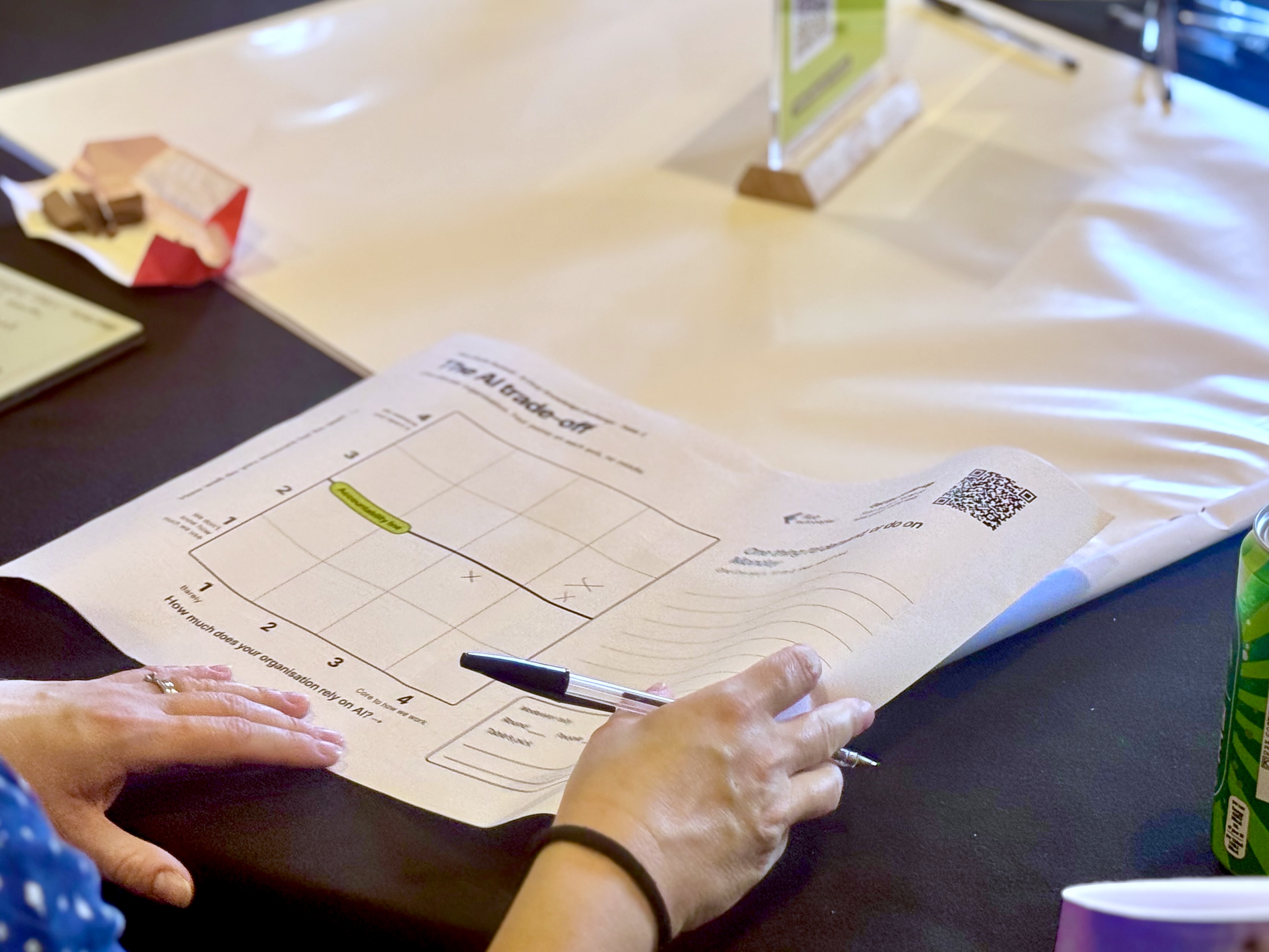
Thirty-six people across four rounds joined our roundtable at Blue Earth Summit, The AI Trade-Off: Using It Without Compromising What You Stand For. Before saying a word, we asked each of them to place a marker on a simple grid to score how much their organisation relies on AI, versus how well it accounts for that use.
Eight people put themselves at the top for reliance and just one put themselves at the top for accountability.
That gap tells a story. Sixteen people, 44% of the room, rated their accountability below their reliance. A third rated the two on the same level, and the remaining eight (22%) rated accountability higher. It suggests that accountability tends to follow usage rather than lead it.
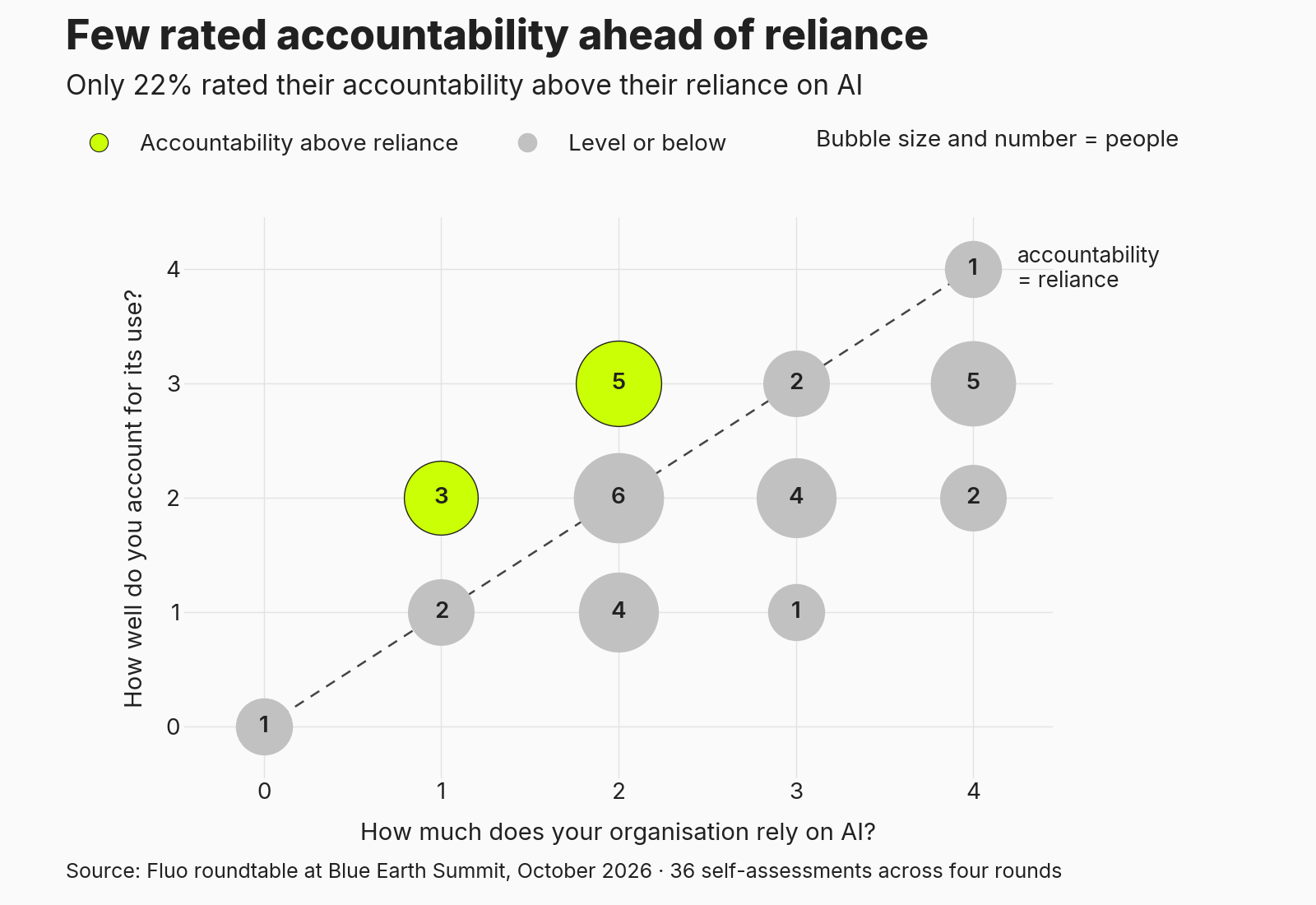
It’s worth stressing that this was just a show of hands in the room, not a structured survey. Thirty-six self-assessments from people who chose to join a session on AI trade-offs is not really a representative sample. But the grid matched what the room went on to discuss afterwards.
One of the clearest problems raised in the session was data. Organisations that already report their emissions struggle to bring AI into the picture. The numbers they need are held by their suppliers, and suppliers are not handing them over.
One participant suggested a fix: show people what each prompt costs in water or electricity, translated into something tangible, like trees, or bottles of water. Make the footprint visible and people will think twice.
The instinct is right, as visibility often changes behaviour. But the per-prompt figures we have so far point the other way.
In August 2025 Google published its own estimates. More than a year on, they’re still the per-prompt figures most people quote. A median Gemini text prompt, it said, uses 0.24 Wh of energy, emits 0.03 g CO2e and consumes 0.26 ml of water, about five drops (Google). If you put that on a screen next to every prompt, very few people would think much of it. Five drops looks like a rounding error.
Google deserves credit for publishing a method at all, but the trouble is what it leaves out. Google’s method excludes model training, data storage, network energy and the user’s own device. It also counts only the water used to cool its data centres, yet every kilowatt-hour carries a water footprint from generating the power too, as a June 2026 UN University report points out (UNU-INWEH). And, by Google’s own account, it reports emissions based on the clean energy Google buys (a market basis) rather than the actual mix on the local grid (a location basis) (Google’s technical paper).
That last point matters more than it sounds. The Green Software Foundation stresses that energy efficiency is not the same as carbon efficiency: the same workload can emit very different amounts depending on the local grid, the hardware it uses and the hours when it runs (Green Software Foundation).
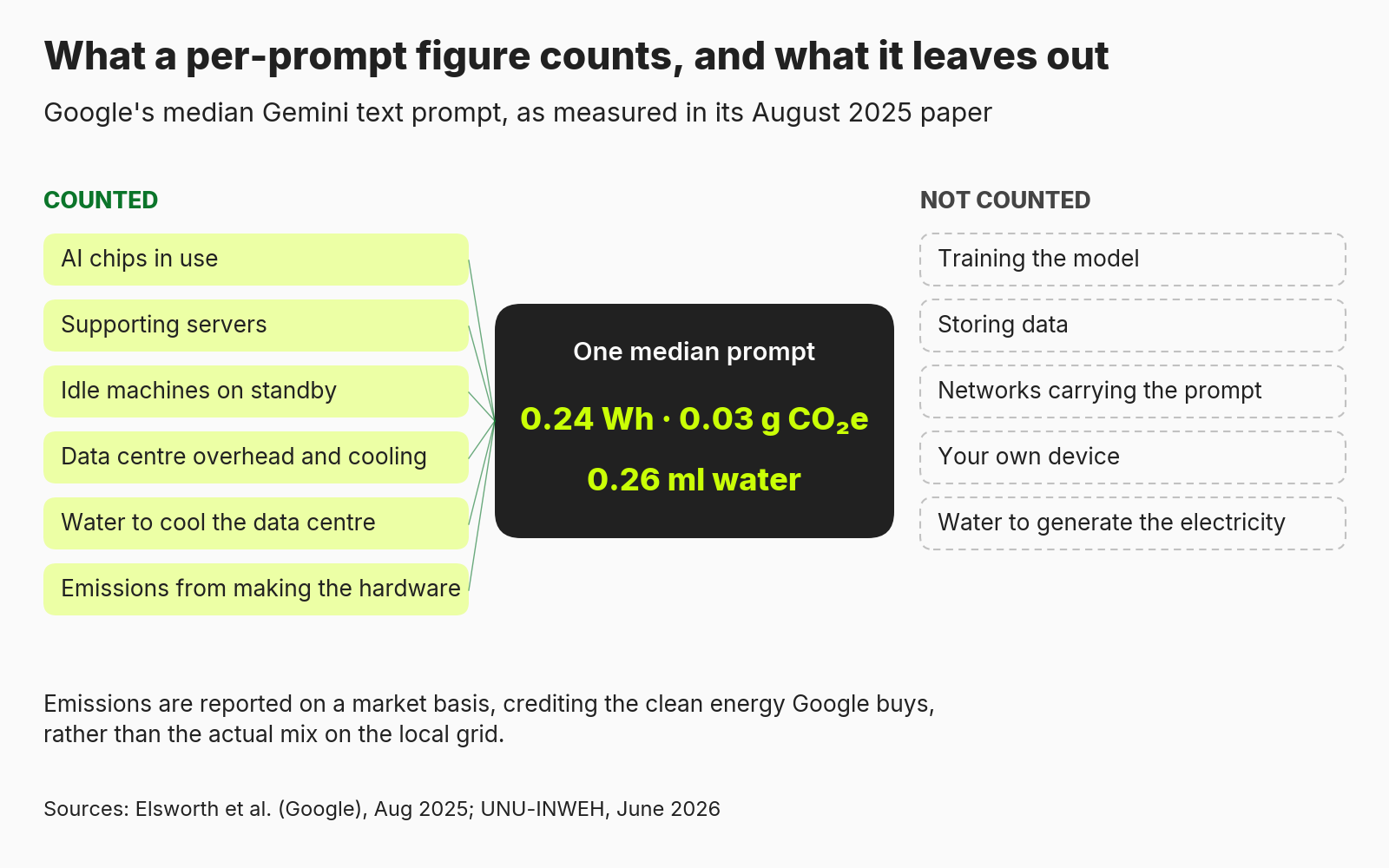
So the room’s idea, applied to today’s publicly available data, would more likely reassure than deter users. The real, invisible footprint sits in the total across every prompt, and in the parts these figures leave out.
Where data is not available, organisations fall back on people. The room described several ways of doing that.
Some have published an AI manifesto or an AI pledge: a public statement of intent. Some have an internal AI policy with named individuals accountable for it. One organisation said it has embraced AI fully and set up an internal AI ethics committee to oversee its use.
Others had taken a quieter route. They keep shared libraries of prompts and skills so staff don’t start from a blank page. That works as governance too: when the approved way is the easiest way, fewer people improvise.
The room was also clear about the upside. Freeing up people’s time came up as a real benefit. The harder question was what using AI well looks like, and who decides.
One participant put it plainly: AI evolves too fast for a business to draw a line with a policy. It needs constant updating.
That doesn’t make policy useless, but it changes its job. One B Corp agency, Yulu, told Fast Company it aims to update its AI guidelines every six months (Fast Company). At the current pace of AI development, even that can feel slow.
At Fluo, we’ve taken a similar line with our own AI pledge. We review it at least once a year, and sooner if our tools, ways of working or the relevant requirements change. It also deliberately names no AI products, so the tools can change without the commitments changing.
Other participants went further: a policy is not enough on its own. What really stops a new tool slipping into the business unchecked is culture. People who notice, ask and push back before anyone has written a rule.
Participants also said the people pushing back hardest on a wide roll-out are often their most junior team members. Their concerns are environmental and social, and they centre on the AI companies themselves.
Leaders may not expect resistance from that direction, and it’s also evidence that culture is already doing much of the governing.
The economics worried people too. AI companies are heavily subsidised and operating at a loss, participants pointed out. What happens to everyone’s workflows when subscription and token prices rise?

According to a company presentation seen by the Financial Times, OpenAI expects to burn through $278 billion in cash between 2026 and 2030. Over the same period, it forecasts revenue growing from $36 billion this year to $350 billion in 2030 (Reuters). Investors are covering the gap for now. Who covers it later is an open question.
Pricing AI today is like judging a restaurant by its opening-week offer. The room had two ideas for changing that.
Both ideas share a conviction worth taking seriously: today’s price tells you very little about the real cost, whether financial, environmental or social.
We use AI every day at Fluo, and we welcome what it does for our work. So our view is simple: AI vendors should tell each customer what that customer’s subscription actually costs, environmentally and socially. And they should be clear about where their data centres are and what those sites do to the places that host them.
Today’s disclosures are like an energy bill that shows the national average instead of your meter reading. Google’s per-prompt figures, for instance, apply fleet-wide averages for grid carbon intensity and water efficiency (Google). Useful for a headline, but not much help for your own carbon report.
This matters more for B Corps than most. B Lab’s chief standards officer, Clay Brown, describes AI use as “effectively a stakeholder governance question”. He says B Corps should ask where the models they use are hosted, whether those data centres follow environmental standards, and how nearby communities are affected. He also says companies with carbon reduction plans should include AI in their calculations (Fast Company).
When we asked B Lab how its new standards treat AI, it pointed to several requirements that may apply:
B Lab added that it may explore tailored standards for the technology industry, and we’d welcome that. We’re planning a group of tech B Corps to keep the conversation on AI and emerging technologies going within the B Corp community, and to contribute to B Lab’s standards work through its own processes.
So B Corps may need targets, risk assessments and emissions figures for their AI use. The problem is who holds the data. In the Fast Company article, VU Amsterdam researcher Alex de Vries-Gao says the suppliers are not transparent, and asks how anyone can be accountable without the information.
The call for disclosure is getting louder. In June 2026, at London Climate Action Week, UN Secretary-General António Guterres launched an AI Environmental Transparency Initiative. It calls on major AI companies to publish the full environmental impacts of their systems and to power all their data centres with renewable energy by 2030 (UN University). It was prompted by the same UN University report cited earlier, which also urged governments to require standardised environmental footprint reporting for AI.
Businesses are pushing from the buyer’s side too. BSR, a global sustainable business network, already advises companies to ask cloud and data centre providers for their energy and water data (BSR). In 2026 it went further, bringing AI users together to agree shared standards for disclosure and procurement and to press the major providers on their sustainability performance (BSR).
It’s a question we face ourselves. Our AI pledge commits us to considering providers’ environmental and ethical practices when we choose tools. Today, the evidence available to do that properly is thin. And while we are working on it, our own carbon footprint doesn’t yet include our AI use. That’s exactly why we’re making this case.
So here is what we’d like every AI vendor to provide:
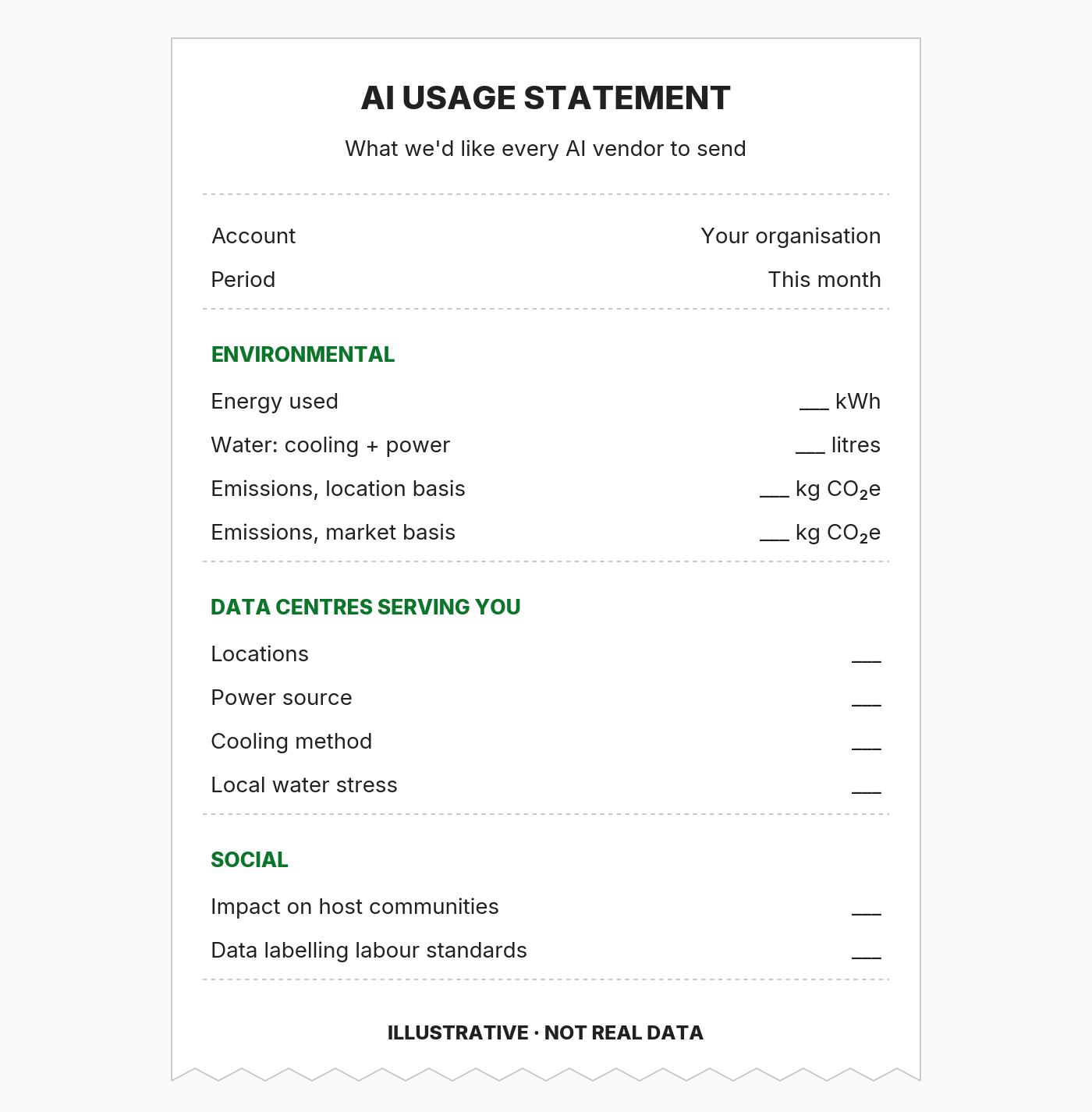
With that data, the room’s idea of showing the footprint becomes valuable. A visual built on your own usage would tell you something useful to make informed choices. A visual built on a fleet median minimises the problem and just tells you to relax.
Until vendors provide this, the most useful thing any of us can do is ask. At renewal, in procurement and in the supplier questionnaire you already send everyone else.
Accountability starts with a clear receipt. Right now, most AI vendors aren’t issuing one.
If you have questions about AI in your organisation, whether that’s training your team, setting up governance or working out what good practice looks like under the B Lab Standards, we’re happy to talk it through. And if you’re a tech B Corp interested in joining the group, we’d like to hear from you too.
Email marco@fluo.tech.